

Hiking Backpacks
Backpacks are ranked here on liters of capacity per kilogram of empty pack — the clearest published measure of whether a pack earns the weight it adds before you have put anything in it.
Pages in This Section
Backpack Spec Comparison
Packs ranked on liters per kilogram, with the category baseline alongside, so you can see which packs carry their own weight and which do not.
How Much Pack Volume You Actually Need
What liter figures mean in practice, how trip length maps to capacity, and why buying larger than you need reliably makes your load heavier.
The Ranking Rule
Packs are ordered by liters of stated capacity per kilogram of empty pack weight. A 50 liter pack weighing 1.0 kg scores twice as well as a 50 liter pack weighing 2.0 kg.
The logic is simple: every gram of pack is a gram you carry in addition to your gear. A pack that provides more volume per gram of itself is doing its structural job more efficiently. What the ratio cannot see is suspension quality, hip-belt design, frame stiffness and load transfer — and those are precisely what make a heavier pack worth carrying under load. Read the section below before treating a high score as a recommendation.
What the Category Looks Like
The median pack in our data sits at roughly 27 liters and around 0.50 kg empty. That is a daypack, and it reflects what actually sells: the market is dominated by day-hiking and travel packs rather than by multi-day backpacking loads.
This matters when reading the rankings. A 30 liter frameless daypack will almost always beat a 65 liter internal-frame pack on liters per kilogram, because it has no frame, no substantial hip belt and no load-transfer structure to carry. That does not make it a better pack — it makes it a different kind of object. The ratio is most meaningful within a size band, and the comparison page groups packs accordingly.
Data quality note. Capacity is stated on around two-thirds of the packs we track, but almost always in the product title or description rather than a structured specification field — “65L Internal Frame” rather than a labeled capacity attribute. That is weaker provenance than a specification table, with one useful side effect: because the figure comes from the product name itself, it always describes the product being named. This category is close to free of the size-variant mismatch problem that affects tents.
Where Liters Stop Being Comparable
Stated capacity is not a standardized measurement. Brands calculate it differently — some count only the main compartment, others include every pocket, lid and external stretch panel. A 40 liter pack from one brand can hold visibly more than a 40 liter pack from another.
Treat a liter figure as approximate, and be especially wary of comparisons between brands at the same nominal size. Within a single brand’s range, capacity figures are usually consistent with each other, which makes intra-brand comparisons more reliable than cross-brand ones.
Hydration packs distort the picture further: a listing may quote the bladder volume rather than the pack’s carrying capacity, which is why a pack described as “2L” is not a two-liter pack.
What the Ratio Misses
This is the category where the ranking rule most needs its limits stated, because the specification that matters most is not published at all.
- Load transfer. A proper frame and hip belt move weight from your shoulders onto your hips. Above roughly 12–15 kg of total load, that structure is not optional, and it is exactly what makes a pack heavier.
- Torso fit. Pack sizing is measured on torso length, not height. A well-fitted heavier pack outperforms a poorly-fitted lighter one comprehensively.
- Durability. Ultralight fabrics achieve their weight by being thinner. That is a legitimate trade, but it is a trade.
- Organization. Whether a pack has the pockets and access you want is not a number and does not appear in this ranking at all.
Which Should You Choose?
- Day hikes, under 8 kg carried: a frameless pack scoring well on liters per kilogram is a genuinely good choice. There is little load to transfer, so the frame you are not carrying is pure gain.
- Overnight and weekend trips, 8–15 kg: the ratio is useful for shortlisting within the 40–55 liter band, but do not pick the lightest option without checking it has a real hip belt.
- Multi-day, over 15 kg: prioritise suspension and fit over the ratio entirely. At this weight a heavier, well-structured pack carries better and hurts less.
- Travel rather than hiking: access, lockability and carry-on dimensions matter more than efficiency. The ranking will not reflect any of those.
Related Categories
- Sleeping Bags — usually the bulkiest single item a pack has to swallow, ranked on warmth per kilogram.
- Camping Tents — the other large carried item, ranked on weight per sleeper.
- Camping Stoves — where a few hundred grams is often the easiest weight saving available.
Common Questions
Is the lightest pack the best pack?
Only at low loads. Below about 8 kg, a light frameless pack is often ideal. Above roughly 15 kg, the frame and hip belt that make a pack heavier are what make it bearable, and the lightest option becomes the wrong answer.
What size pack do I need?
Roughly: 20–30 liters for day hikes, 35–50 for one or two nights, 50–65 for longer trips, and above 65 only for extended, winter or gear-heavy expeditions. Buying larger than needed is a reliable way to end up carrying more, because packs get filled.
Why do two 50 liter packs hold different amounts?
Because capacity is not measured to a standard. Brands differ on whether pockets, lids and external panels count. Treat liter figures as approximate, and be skeptical of close comparisons across brands.
Does the ranking account for fit?
No, and fit matters more than anything the ranking does measure. Use liters per kilogram to build a shortlist, then check torso sizing and, if you can, load a pack with real weight before buying.
Why is the median capacity only about 30 liters?
Because day-hiking and travel packs dominate what sells. The baseline describes the market, not the ideal backpacking pack, which is why the comparison page groups packs by size band.
Compare them
The finder below is already scoped to this class — 60 of the 429 items in the corpus. Widen or narrow it from there, or open the full camp gear finder to search everything at once. Every result is placed against the median for its own size band, where that band holds at least eight products with a stated figure.
60 items match
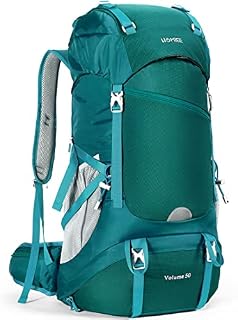
HOMIEE 50L Hiking Backpack Travel Bag Waterproof Camping Rucksack | Lightweight, Rain Cover, Hydration-Ready, Tripod Straps, Load Compression, Survival Whistle, Ideal For Men, Women
Weight
0.45kg
Backpacks · under 1 kg · 47 items
Weight is +5% against the class median of 0.43.
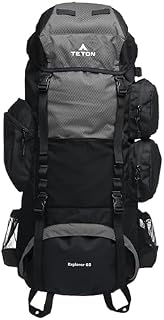
Teton 65L Explorer Internal Frame Backpack for Hiking, Camping, Backpacking, Rain Cover Included, Graphite
Weight
2.27kg
Too few items in this class to publish a baseline.

Teton 55L Scout Internal Frame Backpack for Hiking, Camping, Backpacking, Travel, Rain Cover Included, Olive
Weight
1.86kg
Too few items in this class to publish a baseline.
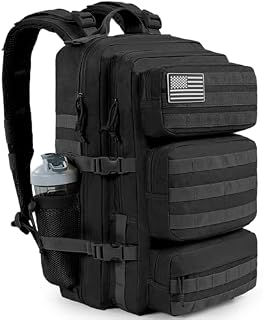
50L Military Tactical Backpack Large Day Backpack for Men Molle Army 3 Days Assault Pack Bug Out Bag Water Resistant and Heavy Duty Hiking Treeking Rucksack – Black
Weight
1.41kg
Too few items in this class to publish a baseline.
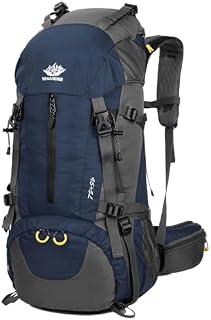
WoneNice 50L(45+5) Waterproof Hiking Backpack Outdoor Daypack w/Rain Cover
Weight
1.16kg
Too few items in this class to publish a baseline.

G4Free 50L Hiking Backpack Waterproof Daypack Outdoor Camping Climbing Backpack with Rain Cover for Men Women | Durable Material Waterproof, Capacity: 50L, Size: 14.2 x 9.4 x 23.6 inches, Outdoor, Hydration Bladder Compartment
Weight
1.13kg
Too few items in this class to publish a baseline.

Hiking Backpack for Men 70L/100L Camping Backpack Military Rucksack Molle 3 Days Assault Pack for Climbing | Camping Backpack
Weight
1.00kg
Backpacks · under 1 kg · 47 items
Weight is +132% against the class median of 0.43.

Maelstrom 40L Hiking Backpack, Lightweight Camping Daypack with Rain Cover | Water-Resistant Rip-Stop Nylon, Wet/Dry Separation, Multi-Pockets, Survival Whistle. Ideal For Men, Women, Travel, Trekking
Weight
0.96kg
Backpacks · under 1 kg · 47 items
Weight is +123% against the class median of 0.43.

The North Face Recon Everyday Laptop Backpack, Timber Tan, One Size | Daypack, Water Repellent, Laptop Sleeve, 2 Water Bottle Pockets
Weight
0.91kg
Backpacks · under 1 kg · 47 items
Weight is +110% against the class median of 0.43.

WATERFLY Lightweight Packable Hiking Backpack, 30L Day Pack Blue | Water Resistant Foldable Travel Daypack with Multiple Pockets, Wet Pocket, Ultralight Day Pack for Woman Man, Everyday Carry
Weight
0.40kg
Backpacks · under 1 kg · 47 items
Weight is -7% against the class median of 0.43.
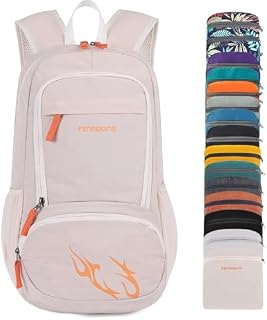
FENGDONG 35L Lightweight Foldable Waterproof Packable Travel Small Hiking Backpack Daypack for men women
Weight
0.37kg
Backpacks · under 1 kg · 47 items
Weight is -14% against the class median of 0.43.

MIYCOO Ultralight Packable Backpack, 35L Waterproof Hiking Daypack | Travel Camping Foldable Daypack, Hiking Back Pack for Men Women, Black
Weight
0.36kg
Backpacks · under 1 kg · 47 items
Weight is -16% against the class median of 0.43.