
Lantern Spec Comparison
The camping lantern category baseline — brightness, runtime and weight — plus the reason the two headline figures should never be read as describing the same moment.
The Category Baseline
Computed from 60 lanterns with published specification data.
| Specification | Coverage | P25 | Median | P75 |
|---|---|---|---|---|
| Brightness (lumens) | 55% | 250 | 540 | 1,000 |
| Runtime (hours) | 60% | 12 | 16 | 55 |
| Weight (kg) | 82% | 0.26 | 0.41 | 0.67 |
Coverage here is the lowest of any category we rank. Brightness is stated on a little over half of listings and, in every case we found, came from marketing copy rather than a structured specification field. Runtime is better sourced — usually a structured field — which is the opposite of what most buyers would assume.
The Two Figures Describe Opposite Settings
Read the brightness and runtime columns above as describing different modes of the same lantern, because that is what they are. The lumen figure is peak output; the runtime figure is almost always the lowest setting.
The gap between the runtime P25 of 12 hours and the P75 of 55 hours is not mainly a battery-capacity difference. It largely reflects how dim a brand is willing to go when quoting its longest runtime. A lantern claiming 100 hours and one claiming 12 may deliver similar light over a charge.
What to look for instead: runtime quoted at a stated output — “20 hours at 200 lumens”. Brands publishing a mode table with output and runtime for each are giving you real information, and they are a minority.
How Much Light You Need
The category median of 540 lumens is well above what most camping uses require. Tent interiors are comfortable at 100–200 lumens; a cooking area or table wants 300–500. Peak figures above that are for short bursts.
This is why a lantern in the lowest brightness quartile is not automatically a poor choice. A 220 lumen lantern with good diffusion and a long runtime at a usable setting will serve better than a 1,000 lumen unit that glares and runs for two hours at full output.
Runtime Values Include Obvious Errors
Published runtime figures in this category include values that are not physically meaningful — listings quoting runtimes in the tens of thousands of hours, which describes an LED’s rated lifespan rather than a battery’s endurance.
Those values sit at the extreme of the distribution, so they would dominate any ranked table of “longest-running lanterns” while barely affecting the median. That is the core reason this page publishes quartiles rather than a product leaderboard, and the reasoning is the same across the site — see the methodology.
Fuel Lanterns Sit Outside These Bands
Propane and liquid-fuel lanterns are brighter than the LED products that dominate this baseline, and their published weight excludes the fuel canister entirely. Any weight-based comparison flatters them in proportion to how much fuel they burn. They also must never be used inside a tent: burning fuel produces carbon monoxide, which is odorless and gives no warning before it affects you.
Compare fuel lanterns against each other, never against the rechargeable models these bands mostly describe.
Using This Page
- Backpacking: under 0.26 kg puts a lantern in the lightest quarter. Ignore peak brightness; look for a usable low mode.
- Car camping: weight is irrelevant. Prioritise light quality and runtime at a mid setting.
- Emergencies: replaceable batteries and long low-output runtime beat everything in these bands.
- Any lantern: treat a quoted lumen figure as a marketing claim, because that is literally where it came from.
The Products These Figures Come From
Of the 60 lanterns in this category, 23 publish every figure in the baseline above. The 10 shown here are listed by price tier, then alphabetically — this is not a ranking, and a product appearing here means its listing is complete, nothing more. 4 listings are held back for a published figure far outside the category’s own range — a data defect rather than an unusual product.
| Product | Brand | Price Tier | Brightness (lm) | Runtime (h) | Weight (kg) | Key Details |
|---|---|---|---|---|---|---|
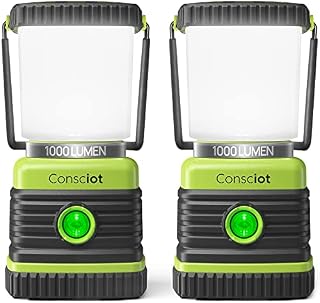 Consciot 1000LM Battery Powered LED Camping Lantern Consciot 1000LM Battery Powered LED Camping Lantern |
Consciot | <$30 | 1,000 | 12.0 | 0.99 | Waterproof · Tabletop Mount · IPX4 |
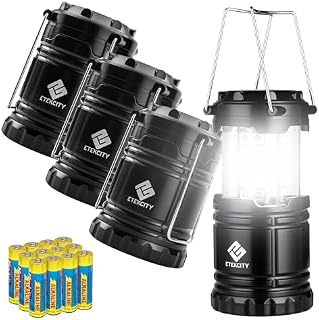 Etekcity LED Camping Lanterns Etekcity LED Camping Lanterns |
Etekcity | <$30 | 154 | 50.0 | 0.26 | Water Resistant · Tabletop Mount · FCC, RoHS |
 Eveready LED Camping Lantern 360 PRO (3-Pack) Eveready LED Camping Lantern 360 PRO (3-Pack) |
EVEREADY | <$30 | 350 | 16.0 | 1.11 | Not Water Resistant · Tabletop Mount |
 Eveready LED Camping Lantern X-250 (2-Pack) Eveready LED Camping Lantern X-250 (2-Pack) |
EVEREADY | <$30 | 250 | 100.0 | 0.66 | Not Water Resistant · Tabletop Mount · IPX4 |
 Lepro 1000LM Battery Powered LED Camping Lantern with 4… Lepro 1000LM Battery Powered LED Camping Lantern with 4… |
Lepro | <$30 | 1,000 | 12.0 | 0.40 | Water Resistant · Tabletop Mount · IPX4 |
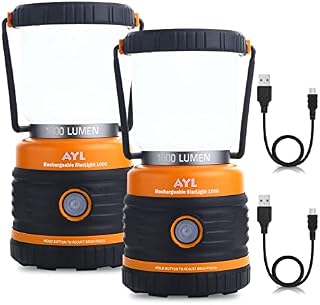 AYL LED Camping Lantern Rechargeable AYL LED Camping Lantern Rechargeable |
AYL | $30-75 | 1,800 | 12.0 | 1.16 | Water Resistant · Tabletop Mount · IP 44 |
 Coleman 400L LED Lantern Coleman 400L LED Lantern |
Coleman | $30-75 | 400 | 30.0 | 0.64 | Water Resistant · Tabletop Mount · IPX4 |
 innofox LED Camping Lantern innofox LED Camping Lantern |
innofox | $30-75 | 1,500 | 36.5 | 0.73 | Not Water Resistant · Ceiling Mount · IPX4 |
 Lepro 1000LM LED Camping Lantern Rechargeable Lepro 1000LM LED Camping Lantern Rechargeable |
Lepro | $30-75 | 1,000 | 12.0 | 0.55 | Water Resistant · Ceiling Mount · IP 44 |
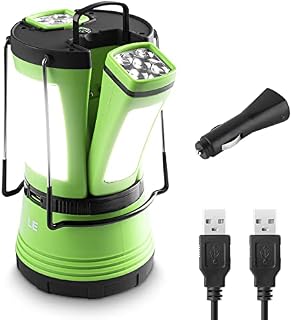 Lepro LE LED Camping Lantern Rechargeable Lepro LE LED Camping Lantern Rechargeable |
Lepro | $30-75 | 600 | 6.0 | 0.72 | Water Resistant · Tabletop Mount · IPX4 |
Key Details are the listing’s own structured specification rows — water resistance level, mounting type, specification met — reproduced as published.
Notes on the Products at the Edges
Most of the products above sit inside the interquartile range on every figure, which is what the baseline already describes. These are the ones it does not: each is outside P25 or P75 on at least one published figure. The position is computed from the category statistics; the explanation is what the listing itself states.
AYL LED Camping Lantern Rechargeable — AYL, $30-75
Weight of 1.16 kg sits above the category P75 of 0.67 kg. The mass follows the battery: a 4400mAh cell driving 46 LEDs at a stated 1800 lumens, doubling as a power bank for up to 12 hours.
Eveready LED Camping Lantern 360 PRO (3-Pack) — EVEREADY, <$30
Weight of 1.11 kg sits above the category P75 of 0.67 kg. A 3-pack, so the figure is three lanterns: each is rated up to 350 lumens in area mode and 60 lumens as a directional flashlight.
Eveready LED Camping Lantern X-250 (2-Pack) — EVEREADY, <$30
Runtime of 100.0 h sits above the category P75 of 55.0 h. The listing states up to 100 hours in area mode at 250 lumens — a long-burn, modest-output design rather than a bright one.
Specifications are the manufacturer’s published values as scraped for this corpus, not our own measurements — the same source, and the same limits, as the baseline above. Prices move daily, so we show the tier rather than an amount. Links to Amazon are affiliate links.
FAQ
Is 540 lumens what I should aim for?
No — that is the category median, not a recommendation. Most camping is comfortable well below it, and a lower-output lantern with better diffusion is often the more usable choice.
Why is brightness coverage only 56%?
Because many listings never state a lumen figure at all, describing brightness only in adjectives. Those products cannot enter the baseline.
Why is runtime better sourced than brightness?
Because retailers expose a battery-life specification field that brands fill in, while lumen figures live in titles and bullets. It is a quirk of how listings are structured rather than anything about the products.
Do these figures include headlamps?
The retail category includes some, though the baseline is intended for area lighting. A headlamp and a lantern solve different problems.