

Camping Stoves
Stoves are ranked here on BTU per kilogram, read alongside fuel type. Raw output favors heavy stoves; the ratio shows what you actually gain for the weight — though on this one, fuel type changes the answer more than the number does.
Pages in This Section
Stove Spec Comparison
Stoves ranked on BTU per kilogram against the category baseline, grouped by fuel type so the comparison stays meaningful.
Choosing a Fuel Type
Canister, propane, liquid fuel and wood compared on what each actually costs you in weight, cold-weather performance and convenience.
The Ranking Rule
Stoves are ordered by stated BTU output per kilogram of stove weight. A 10,000 BTU stove at 0.5 kg scores twice as well as a 10,000 BTU stove at 1.0 kg.
BTU is a heat output figure — how fast the stove can deliver energy. On its own it favors large two-burner units. Divided by weight, it asks how efficiently a stove converts carried mass into cooking power, which is the relevant question when the stove goes in a pack.
Safety, before any specification. Every fuel stove produces carbon monoxide — colorless, odorless, and with no sensory warning. Never run a stove inside a tent, vestibule or closed vehicle, and never use one for heating. A clean blue flame still produces CO, and the early symptoms are indistinguishable from ordinary camping tiredness. Full detail in the fuel type guide.
Fuel weight is not included. Published stove weight excludes the canister, bottle or cylinder. A 300 g canister stove needs 200–450 g of fuel to be useful, and a propane stove needs considerably more. On a per-gram measure this flatters every stove roughly in proportion to how much fuel it burns. Compare within a fuel type, never across.
What the Category Looks Like
The median stove in our data produces about 20,000 BTU and weighs roughly 1.4 kg. That combination describes a two-burner propane camp stove — the car-camping default — rather than a backpacking burner, which reflects what sells rather than what a hiker would choose.
BTU is stated on exactly half the listings we track, the lowest coverage of any figure we rank on, and it sits close enough to our publication threshold that it may fall below it as we widen the dataset. It also comes entirely from marketing copy rather than structured specification fields. Treat the stove rankings as the least robust on this site.
BTU Is Not Efficiency
This is the most common misreading of the category. BTU measures how fast a stove can burn fuel, not how well it turns that fuel into hot food.
A high-output burner with poor wind protection and no heat exchanger can easily use more fuel to boil a liter of water than a modest, well-designed integrated system. Integrated cooking systems — where the pot and burner are engineered together — routinely achieve better real fuel economy than free-standing burners with higher BTU figures.
Neither fuel consumption nor boil time is published consistently enough to compare, which is a real limitation of ranking this category on specifications. BTU per kilogram tells you about power density. It does not tell you which stove empties a canister first.
Fuel Type Changes Everything
Fuel type is stated on around six in ten listings and matters more than the ranking does:
- Isobutane canister. The backpacking standard. Light, simple, and the fuel weight is easy to plan. Output falls in cold weather as canister pressure drops.
- Propane. Car camping. High output, cheap fuel, cylinders far too heavy to carry any distance.
- Liquid fuel. Refillable, performs in genuine cold and at altitude, and needs priming and maintenance. Heavier stove, lighter fuel logistics on long trips.
- Wood. No fuel to carry at all, which no weight ratio can represent. Slow, smoky, weather-dependent, and prohibited wherever there is a fire ban.
Which Should You Choose?
- Solo and lightweight trips: a canister stove or integrated system. Ignore BTU per kilogram in favor of a system with wind protection and a stable pot support.
- Car camping for a group: a two-burner propane stove. Weight is irrelevant; buy for simmer control and a burner spacing that fits real pans.
- Winter or high altitude: liquid fuel, or a canister stove with a pressure regulator. Standard canister stoves lose output exactly when you need it.
- Long expeditions: liquid fuel, because refillable bottles beat carrying a fortnight of canisters.
Related Categories
- Camping Lanterns — the other category where excluded fuel weight distorts a per-gram ranking.
- Hiking Backpacks — stove and fuel together are usually an easy place to save weight.
- Camping Coolers — the other half of a car-camping kitchen.
Common Questions
Is a higher BTU stove better?
Not usually. Higher BTU means faster heat, not more efficient heat. A high-output burner with no wind protection can use more fuel per meal than a modest integrated system, and a stove that cannot simmer will burn food.
Why do you rank on BTU if it does not measure efficiency?
Because it is the only output figure published often enough to compare. Fuel consumption and boil time would be better and are not available. We would rather rank on an imperfect published figure and say so than invent a score.
How much fuel should I plan for?
As a rough guide, a 230 g isobutane canister covers two to three days of simple cooking for one person. Cold weather, melting snow and boiling large volumes all increase that substantially.
Why is the stove ranking described as the least robust?
Because BTU appears on only about half the listings, comes from marketing copy rather than a specification field, and sits close to our publication threshold. All three weaknesses stack in the same direction.
Do wood stoves really weigh nothing to run?
They carry no fuel, which is a genuine advantage on long trips. In exchange you get slow cooking, sooty pots, dependence on dry fuel, and a stove you cannot legally use during a fire ban.
Compare them
The finder below is already scoped to this class — 60 of the 429 items in the corpus. Widen or narrow it from there, or open the full camp gear finder to search everything at once. Every result is placed against the median for its own size band, where that band holds at least eight products with a stated figure.
60 items match

Coleman BottleTop Propane Stove with Adjustable Burner, Portable Camping/Backpacking Cooker with 7650 BTUs of Power for Camping, Tailgating, Grilling, & More
Weight
0.01kg
Stoves · under 1 kg · 22 items
Weight is -96% against the class median of 0.28.

Bestfire 2 Burner Propane Stove, 150,000 BTU High Pressure Camping Burner | with Windscreen, Side Shelves, Removable Legs, CSA Certified for Outdoor BBQ Backyard Cooking
- Capacity
- not stated
- Sleeps
- not stated
- Temp rating
- not stated
Weight
18.14kg
Too few items in this class to publish a baseline.

Coleman Classic 3-Burner Propane Camping Stove with InstaStart Ignition, Portable Cooktop with 3 Adjustable Burners & 28,000 BTUs of Power for Camping, Tailgating, Grilling, Hunting & More
- Capacity
- not stated
- Sleeps
- not stated
- Temp rating
- not stated
Weight
8.50kg
Too few items in this class to publish a baseline.
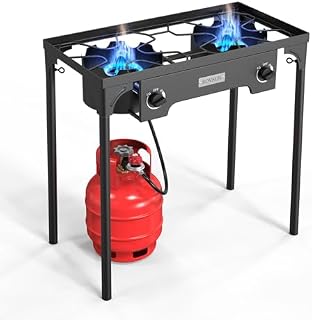
ROVSUN 2 Burner Outdoor Propane Gas Stove with Adjustable Regulator, 150,000 BTU High Pressure Stand Cooker for Backyard Cooking Camping Home Brewing Canning Turkey Frying
- Capacity
- not stated
- Sleeps
- not stated
- Temp rating
- not stated
Weight
5.99kg
Too few items in this class to publish a baseline.

FineFlame Camping Stove, Propane Portable Camp Stove, 20400BTU-3 Burners | With Toaster & Regulator, Push-Button Instant Ignition, Adjustable Burners, Wind Guards, For Car BBQ Outdoor Camping Cooking
Weight
4.54kg
Stoves · 2.5-5 kg · 10 items
Weight is +13% against the class median of 4.01.
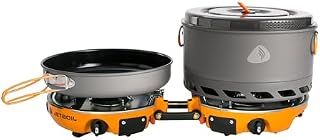
Jetboil Genesis Basecamp Backpacking and Camping Stove Cooking System with Camping Cookware
- Capacity
- not stated
- Sleeps
- not stated
- Temp rating
- not stated
Weight
4.13kg
Stoves · 2.5-5 kg · 10 items
Weight is +3% against the class median of 4.01.

Coleman Fold ‘N Go 2-Burner Propane Stove, Dual Adjustable Burners with 20,000 BTUs of Power & InstaStart Ignition, Great for Camping, Tailgating, Grilling, & More
- Capacity
- not stated
- Sleeps
- not stated
- Temp rating
- not stated
Weight
4.08kg
Stoves · 2.5-5 kg · 10 items
Weight is +2% against the class median of 4.01.

ODSD 2 Burner Camping Stove with Windshield, 20000 BTU Propane Camp Stove, Portable Folding Gas Stove, Camping Essentials Gear Includes Frying Pan, Coffee Stand & Carry Bag, Green
Weight
3.93kg
Stoves · 2.5-5 kg · 10 items
Weight is -2% against the class median of 4.01.

Coleman Triton 2-Burner Propane Stove, Portable Camping Cooktop with 2 Adjustable Burners & Wind Guards, 22,000 BTUs of Power for Camping, Tailgating, Grilling, BBQ, & More
- Capacity
- not stated
- Sleeps
- not stated
- Temp rating
- not stated
Weight
2.27kg
Stoves · 1-2.5 kg · 13 items
Weight is +61% against the class median of 1.41.

BESTFIRE Portable Dual Fuel Camping Stove – 10,000 BTU Butane and Propane Stove with Adapter & Case – Single Burner Gas Stove for Outdoor Cooking, Tailgating & Emergency
- Capacity
- not stated
- Sleeps
- not stated
- Temp rating
- not stated
Weight
2.22kg
Stoves · 1-2.5 kg · 13 items
Weight is +58% against the class median of 1.41.

Iwatani 35FW Single-Burner Butane Portable Cooktop Indoor & Outdoor Cooking Stove Medium
Weight
2.00kg
Stoves · 1-2.5 kg · 13 items
Weight is +42% against the class median of 1.41.

Gas One Portable Butane Camping Stove with Case: Automatic Ignition, Precise Heat Control – Camping & Tailgating and Outdoor Cooking
- Capacity
- not stated
- Sleeps
- not stated
- Temp rating
- not stated
Weight
1.41kg
Stoves · 1-2.5 kg · 13 items
Weight is 0% against the class median of 1.41.