

Stove Spec Comparison
The camping stove category baseline — heat output and weight — and a frank warning that this is the least well-documented category on the site, with output figures sitting only just above our publication threshold.
The Category Baseline
Computed from 60 stoves with published specification data.
| Specification | Coverage | P25 | Median | P75 |
|---|---|---|---|---|
| Heat output (BTU) | 50% | 10,000 | 20,000 | 26,500 |
| Weight (kg) | 87% | 0.37 | 1.38 | 3.81 |
The median stove — 20,000 BTU at 1.38 kg — is a two-burner propane unit. The weight quartiles show the split in this category clearly: the lightest quarter, under 370 g, is backpacking canister burners, while the heaviest quarter above 3.81 kg is car-camping stoves. These are different products in one category.
Confidence warning. BTU is published on exactly half of listings, comes from marketing copy rather than a structured specification field in every case we found, and sits close enough to our 40% publication threshold that it may fall below it as the dataset widens. Treat the stove figures as the least reliable on this site.
Weight Excludes Fuel, Which Changes Everything
Published stove weight never includes the canister, cylinder or bottle. A 300 g canister burner needs 200–450 g of fuel to be useful; a propane stove needs a cylinder several times its own weight.
Any weight-based comparison across fuel types is therefore comparing incomplete objects, and it flatters each stove roughly in proportion to how much fuel it burns. Compare within a fuel type, and where possible compare total system weight — stove, fuel and pot — for the trip length you actually take.
BTU Measures Speed, Not Efficiency
This is the most consequential misreading in the category. BTU describes how fast a stove delivers heat, not how much of it reaches your food.
A high-output burner with no wind protection loses much of its heat to the air. An integrated system — pot and burner engineered together with a heat exchanger — captures far more, and routinely boils more water per gram of fuel while quoting a lower BTU figure. In other words, the specification this category publishes points away from the more efficient product.
Fuel consumption and boil time would be the right figures. Neither is published consistently enough to compare, which is a genuine limit on what a spec-based comparison can tell you here.
Why No Ranked Table
Ranking stoves by BTU per kilogram produced a top of the list populated by listings with implausible weights — multi-burner stoves recorded at a few hundred grams, and one at ten. Those are specification errors, and a leaderboard sorts them straight to the top because it selects for extremes.
Quartiles are unaffected by a handful of bad values. The same principle applies across the site and is explained in the methodology.
Rough Output Guidance
| Output | Typical product | Suits |
|---|---|---|
| 7,000–11,000 BTU | Single canister burner | Solo and pairs, boiling water |
| 10,000–15,000 BTU | Single high-output or butane stove | Small groups, actual cooking |
| 20,000+ BTU | Two-burner propane | Car camping for a group |
Using This Page
- Backpacking: ignore BTU almost entirely. Choose a canister stove or integrated system with wind protection and a stable pot support.
- Car camping: the 20,000 BTU median two-burner is the standard answer. Buy for simmer control and burner spacing.
- Winter or altitude: fuel type decides this, not output. See the fuel type guide.
- Any stove: a windscreen is the cheapest efficiency gain available, and no specification reflects it.
The Products These Figures Come From
Of the 60 stoves in this category, 27 publish every figure in the baseline above. The 10 shown here are listed by price tier, then alphabetically — this is not a ranking, and a product appearing here means its listing is complete, nothing more. 3 listings are held back for a published figure far outside the category’s own range — a data defect rather than an unusual product.
| Product | Brand | Price Tier | Heat output (BTU) | Weight (kg) | Key Details |
|---|---|---|---|---|---|
 BESTFIRE Portable Dual Fuel Camping Stove – 10 BESTFIRE Portable Dual Fuel Camping Stove – 10 |
BESTFIRE | <$30 | 10,000 | 2.22 | Butane, Propane · Gas Powered |
 Gas One Portable Butane Camping Stove with Case Gas One Portable Butane Camping Stove with Case |
Gas One | <$30 | 7,650 | 1.41 | Butane · Gas Powered |
 vivicreate 7000 BTU Portable Stove vivicreate 7000 BTU Portable Stove |
vivicreate | <$30 | 7,000 | 1.36 | Butane · Gas Powered |
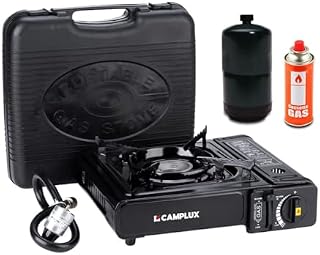 CAMPLUX ENJOY OUTDOOR LIFE Camplux Dual Fuel Propane &… CAMPLUX ENJOY OUTDOOR LIFE Camplux Dual Fuel Propane &… |
CAMPLUX ENJOY OUTDOOR LIFE | $30-75 | 7,200 | 1.50 | Liquefied Petroleum Gas · Dual Fuel |
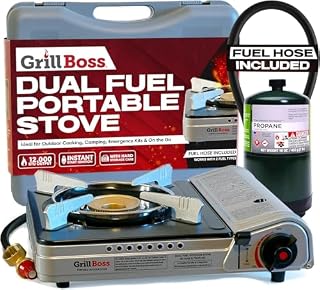 Chef Master Grill Boss Dual Fuel Camping Stove Chef Master Grill Boss Dual Fuel Camping Stove |
Chef Master | $30-75 | 12,000 | 0.23 | Butane, Propane · Gas Powered |
 Coleman BottleTop Propane Stove with Adjustable Burner Coleman BottleTop Propane Stove with Adjustable Burner |
Coleman | $30-75 | 7,650 | 0.01 | Propane · Propane |
 Camp Chef Everest 2X 2-Burner Portable Camping Stove Camp Chef Everest 2X 2-Burner Portable Camping Stove |
Camp Chef | $75-200 | 40,000 | 6.80 | Liquefied Petroleum Gas · Gas Powered |
 Camp Chef Explorer Camp Chef Explorer |
Camp Chef | $75-200 | 30,000 | 2.50 | Liquefied Petroleum Gas · Propane |
 Coleman Classic 3-Burner Propane Camping Stove with… Coleman Classic 3-Burner Propane Camping Stove with… |
Coleman | $75-200 | 28,000 | 8.50 | Propane · Gas Powered |
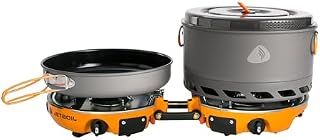 Jetboil Genesis Basecamp Backpacking and Camping Stove… Jetboil Genesis Basecamp Backpacking and Camping Stove… |
Jetboil | $200-500 | 10,000 | 4.13 | Propane · fuel_powered |
Key Details are the listing’s own structured specification rows — fuel type, power source — reproduced as published.
Notes on the Products at the Edges
Most of the products above sit inside the interquartile range on every figure, which is what the baseline already describes. These are the ones it does not: each is outside P25 or P75 on at least one published figure. The position is computed from the category statistics; the explanation is what the listing itself states.
Coleman Classic 3-Burner Propane Camping Stove with… — Coleman, $75-200
Weight of 8.50 kg sits above the category P75 of 3.81 kg. A three-burner tabletop stove rated 28,000 BTU in total with a pressure regulator and push-button ignition: a basecamp stove, not a packable one.
Camp Chef Everest 2X 2-Burner Portable Camping Stove — Camp Chef, $75-200
Weight of 6.80 kg sits above the category P75 of 3.81 kg. Dual 20K burners for 40,000 BTU across a 215 sq in surface, with a folding windscreen lid.
Specifications are the manufacturer’s published values as scraped for this corpus, not our own measurements — the same source, and the same limits, as the baseline above. Prices move daily, so we show the tier rather than an amount. Links to Amazon are affiliate links.
FAQ
Should I buy the highest BTU stove I can?
No. Higher BTU heats faster, not more efficiently, and a stove that cannot simmer will burn food. Pot fit and wind protection matter more.
Why is this category described as least reliable?
Because its key figure is published on only half of listings, comes from marketing text, and sits near our publication threshold. Three weaknesses stacking in the same direction deserve saying out loud.
Why is the weight spread so wide?
Because backpacking burners and two-burner car-camping stoves share one retail category. The quartiles describe two different product types rather than one distribution.
Do the weights include fuel?
No, never. Add 200–450 g for a canister and considerably more for propane when comparing real carried weight.